
Why Viscosity Rises Too Fast in Highly Filled Systems ?
Many formulation teams reach the same point in development:
The system looks fine at lower loading, but once filler content increases, viscosity rises too fast. Processing becomes harder, handling feels less stable, and the formulation window starts to narrow.
At that stage, it is easy to assume the problem is simply “too much filler.”
In reality, filler loading is often only part of the story.
In many highly filled systems, viscosity does not rise only because the filler percentage increases. It rises because the way the filler behaves inside the system becomes harder to control. Particle shape, particle size distribution, morphology consistency, and filler-filler interaction can all play a major role.

Why loading alone does not explain everything
Two formulations can use similar filler levels and still behave very differently.
That usually happens because highly filled systems are sensitive not only to how much filler is present, but to how the particles move, pack, and interact during processing.
Once loading rises, small differences in filler characteristics become more visible:
- internal friction increases
- dispersion becomes more difficult
- movement within the system becomes less smooth
- processability becomes more sensitive to variation
This is why some fillers remain manageable at higher loading while others become much harder to work with.
The role of particle shape
Particle shape is one of the most underestimated variables in viscosity behavior.
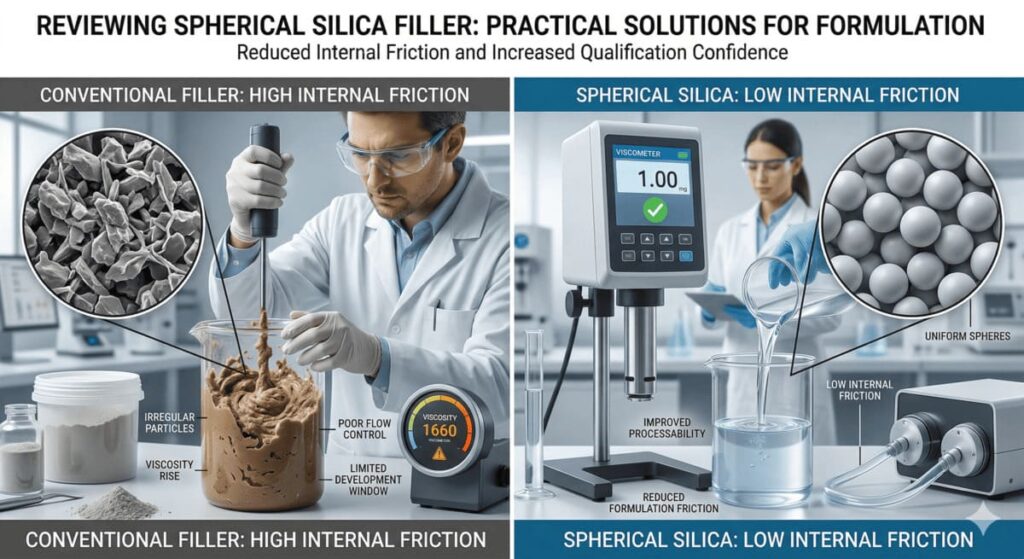
Irregular or angular particles often create more resistance inside the system. As filler content rises, that resistance becomes easier to notice. The formulation may become stiffer, harder to move, or more difficult to process in a stable way.
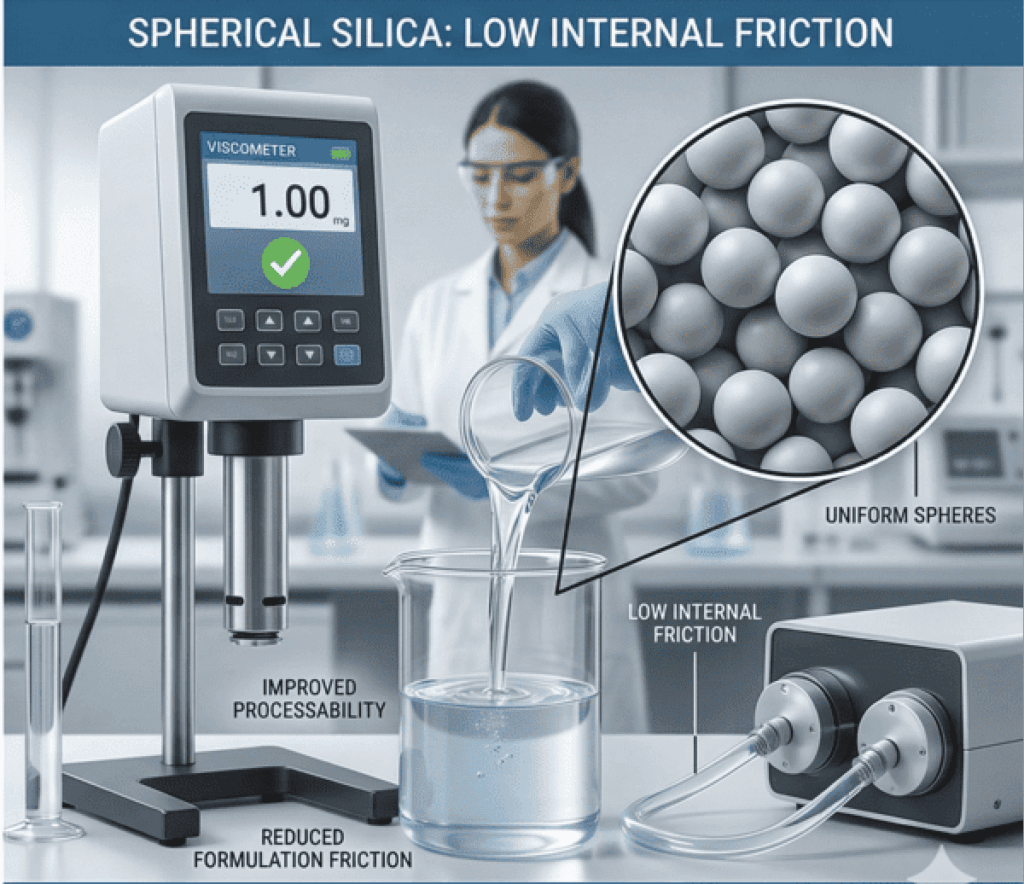
Spherical particles are often reviewed when teams need a more manageable behavior at higher loading. Their more regular shape can help reduce internal friction and support smoother filler movement.
This does not mean spherical silica automatically solves every viscosity issue. But it often gives formulators a more realistic route to balancing filler content and processability.
Why PSD also matters
Particle size distribution is another major factor.
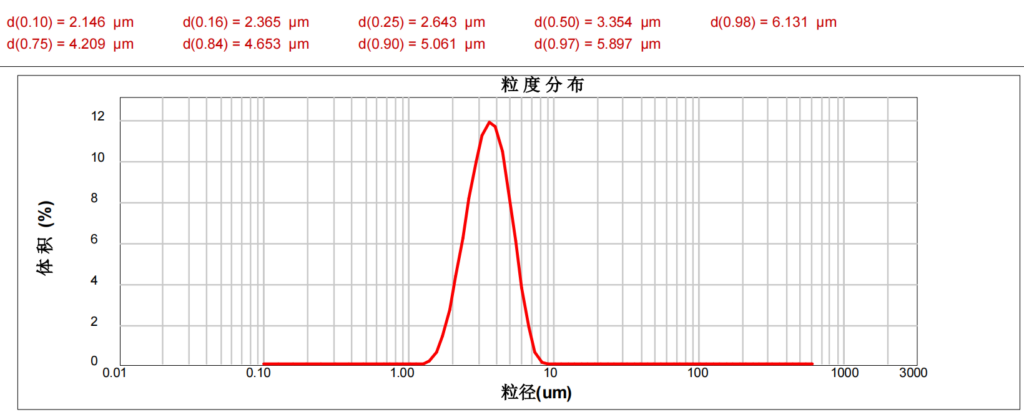
A filler may have acceptable average size on paper, but still behave unpredictably if the distribution does not suit the application. In highly filled systems, PSD can influence how particles pack, how evenly they distribute, and how much resistance they create as loading increases.
That is why teams often compare not only particle size, but how size distribution aligns with their process and qualification targets.
Why viscosity problems often get worse during qualification
A filler that appears manageable in early screening may become much more difficult in broader review.
That happens because qualification usually exposes more conditions:
- different batches
- larger trial scope
- longer review cycles
- more realistic process settings
- tighter consistency expectations
When that happens, viscosity is often one of the first places where hidden filler issues show up.
This is why qualification repeatability matters more than a single acceptable result.

When spherical silica becomes worth reviewing
It usually makes sense to review spherical silica more seriously when:
- viscosity rises too fast as filler loading increases
- processability becomes harder to control
- the system feels too narrow in its handling window
- internal friction appears to be limiting further development
- the team wants to compare a more manageable filler option
- a backup or imported alternative is being evaluated
In many systems, spherical morphology is not just a premium feature. It is a practical way to reduce formulation friction and improve qualification confidence.
What buyers should compare before changing filler grade
Before switching or testing a new filler source, it helps to review:
- particle morphology
- PSD suitability
- dispersion behavior
- repeatability during evaluation
- response speed from the supplier
- how easily the material can be supported during qualification
The best filler is not always the one with the most attractive datasheet. It is often the one that behaves most predictably when the system becomes more demanding.
Final thought
If viscosity rises too fast in a highly filled system, the issue may not be filler content alone. It may be the interaction between loading, morphology, PSD, and processability.
That is often the point where spherical silica deserves a closer look.
Need a more manageable route for high-loading evaluation? Talk to Wanda about sample review, PSD options, and qualification support for spherical silica.
 German
  English
  Spanish
  Russian
  Arabic
  Italian
  Japanese
  Korean
  Portuguese
  Polish
  French